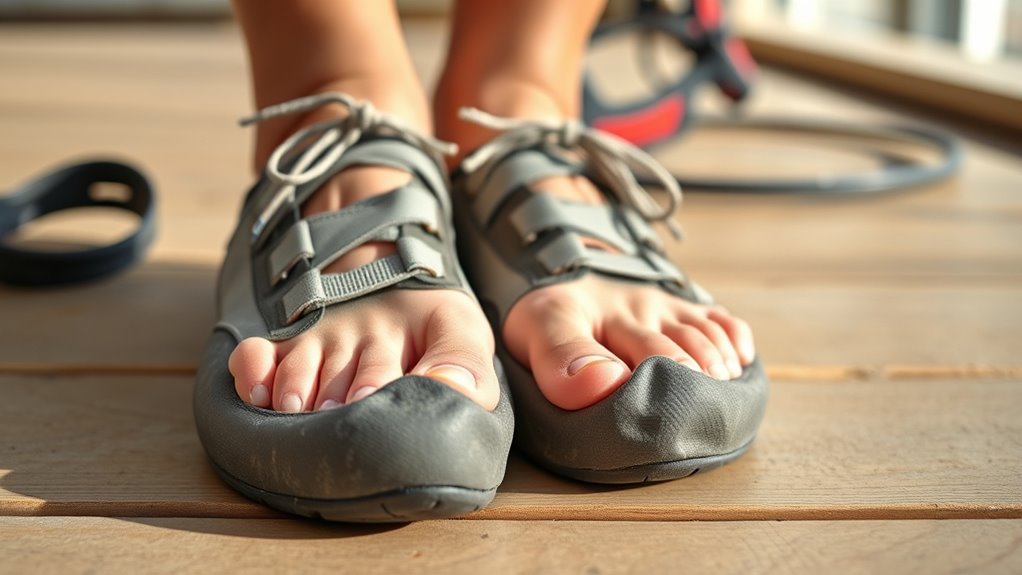
10 Tips on How a Moderate Climbing Shoe Should Fit
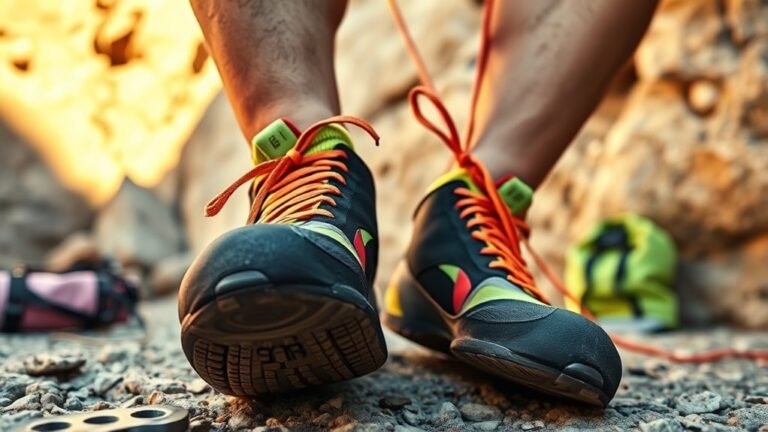
You want a climbing shoe that fits snugly without pain, supporting your foot’s natural shape. A moderate climbing shoe should feel secure but not uncomfortable, striking the perfect balance between performance and comfort.
Guarantee your heel locks in securely with no slipping or pinching.
Your toes should touch the end comfortably, slightly bent for control without cramping. Check that the toe box matches your foot’s contours to avoid dead space. This way, you get precise foot placements without unnecessary pressure.
Choose uppers and closures that suit your fit and climbing style. Keep the shoe secure but comfortable for all-day wear.
There’s more to uncover about achieving perfect fit and performance, so keep these tips in mind!
Key Takeaways
- Ensure the shoe fits snugly without pain, supporting the foot fully with no dead space, especially in the toe box. You want it to feel secure but not uncomfortable.
- The heel should lock in securely without slipping or pinching. This helps provide stable support during climbs, so you don’t lose your footing.
- Toes should touch the shoe front comfortably with a slight bend. Avoid cramping or putting too much pressure on them.
- Choose closure types like laces, straps, or slip-ons that allow precise adjustment. This way, you get a secure, customized fit every time.
- Confirm the shoe supports your natural foot shape and movement. It shouldn’t bunch up or cause discomfort, even when you wear it for a while.
Key Signs a Moderate Climbing Shoe Fits Properly
When you try on a moderate climbing shoe, you want it to fit snugly without causing pain or excessive pressure. A proper fit means your foot feels supported with no dead space, especially at the toe box.
Your heel should be secure, fitting closely without pinching or slipping, even when you stand on your toes. This heel secure fit prevents unwanted movement that could affect your balance.
A secure heel fit prevents slipping and maintains balance, even when standing on your toes.
Minimal movement inside the shoe is essential; your foot shouldn’t slide around as you climb. Also, the sides of the shoe should conform closely to your foot’s shape, providing good control and stability.
Achieving this snug fit ensures you maximize performance and comfort while climbing. It also helps you avoid distractions caused by ill-fitting footwear.
Why Proper Toe Contact Matters for Fit
Although a snug fit might feel tight at first, proper toe contact plays an essential role in climbing performance. When your toes make full contact with the shoe, you get maximum power transfer and control. This is vital for precision on small footholds.
Gaps reduce grip, causing slipping and instability. Your toes should sit comfortably at the end, slightly bent but not painfully pressed. This helps maintain balance and support during overhangs.
| Toe Contact Condition | Effect on Climbing Fit |
|---|---|
| Full contact | Maximum power and control |
| Slight toe bend | Better balance and support |
| Gaps present | Reduced grip, slipping risk |
| Toes crunched | Discomfort, improper fit |
How to Get the Heel Fit Right for Security and Comfort
Securing your heel snugly in a climbing shoe prevents slipping and guarantees stability on the wall. To get the heel fit right, make sure it feels secure without pinching or causing pain.
When you stand on your toes, your heel shouldn’t slide out or pinch your Achilles tendon. A proper heel fit avoids heel lift, which can compromise both performance and safety, especially on technical routes.
The heel rand should gently push your foot forward, improving toe positioning and power transfer. When trying on climbing shoes, check that your heel is fully seated with no gaps or uncomfortable pressure points.
Adjust straps or laces as needed to achieve a secure, comfortable fit that keeps your heel locked in place throughout your climb. It’s all about feeling locked in without any pain or slipping.
Leather vs. Synthetic Uppers: What Fits Best?
When choosing between leather and synthetic uppers, think about how much stretch and breathability you want. Leather will mold to your foot over time but stretches up to half a size.
Synthetic stays firm and offers better airflow. So, if you want your shoes to feel a bit more flexible as you wear them, leather’s a good pick.
Make sure you size leather shoes a bit snug, but get synthetic ones spot-on from the start for the best fit. It’s all about what feels right for you!
Stretching Differences
How much a climbing shoe stretches can make a big difference in comfort and performance. Leather uppers stretch up to half a size during break-in, molding to your foot for a personalized fit.
Synthetic shoes, on the other hand, don’t stretch much, giving you a consistent fit throughout their life. If you want a snug shoe that loosens slightly over time, leather is your best bet.
But if you prefer a stable, unchanging fit, synthetic shoes work better.
| Feature | Leather Uppers | Synthetic Shoes |
|---|---|---|
| Stretching | Up to half a size | Minimal stretch |
| Fit Adjustment | Molds to foot shape | Maintains original fit |
| Break-in Period | Required | Minimal |
| Fit Consistency | Changes with wear | Stable |
| Ideal For | Custom, adjustable feel | Predictable sizing |
Breathability And Comfort
Although both leather and synthetic uppers have their merits, your choice will greatly impact breathability and overall comfort during climbs. Leather uppers naturally offer better breathability and moisture-wicking, keeping your feet cooler and drier as you climb.
If you prefer a shoe that molds to your foot over time, leather’s stretch adds to comfort. On the other hand, synthetic uppers usually don’t stretch much but often include mesh panels or ventilation features, enhancing airflow for breathability.
If consistent fit and immediate comfort matter most, synthetic uppers might suit you better. Ultimately, balancing breathability and comfort means considering how much you want your shoe to stretch and how important airflow is during your climbing sessions.
Choose the upper that fits your climbing style and comfort needs best.
Sizing Consistency
Since sizing plays a crucial role in climbing shoe performance, you need to understand how leather and synthetic uppers behave differently over time.
Leather uppers stretch up to half a size during break-in, so you want a precise initial fit that will mold perfectly to your foot. Synthetic uppers, on the other hand, don’t stretch much, so getting the sizing right from the start is essential for maintaining comfort and performance.
Consider these points for sizing consistency:
- Leather shoes offer a customizable fit through stretching but may become looser with wear.
- Synthetic shoes keep their original fit, providing reliable sizing over time.
If you want consistent fit without worrying about stretching, synthetic uppers are your best bet.
Choosing between leather and synthetic depends on how much fit adjustment you prefer.
How Closure Types Affect Moderate Climbing Shoe Fit
When you choose a closure type for your moderate climbing shoe, you directly affect how securely and comfortably it fits your foot. Lace-up closures offer the most precise adjustment, letting you tailor the fit to your foot’s unique shape and swelling throughout the day.
Straps, like hook-and-loop closures, provide quick and easy fit adjustments but don’t allow for the same fine-tuning as laces. Slip-on shoes rely on a snug, elastic fit that forgoes adjustment but ensures a tight, performance-driven feel.
The closure type also influences how evenly pressure is distributed across your foot, which can impact comfort during climbs. Selecting the right closure helps you balance convenience and customization to achieve the fit that works best for your climbing style and foot shape.
How Shoe Last Shape Influences Fit and Feel
Understanding the shape of a climbing shoe’s last is key to finding a fit that feels both comfortable and responsive on the wall. The shoe last shape determines how the shoe fits snugly around your foot and influences the toe box shape, affecting comfort and performance.
Grasping a climbing shoe’s last shape is essential for comfort and responsiveness on the wall.
Moderate climbing shoes often use a slightly downturned last to balance support and sensitivity. Consider these points when choosing your shoe:
- A straight last offers a relaxed fit with a wider toe box, ideal for all-day comfort.
- An asymmetric last focuses power on your big toe, giving precision on technical climbs.
- A curved last creates a narrow, aggressive toe box for better edging.
Knowing the last shape helps you pick shoes that match your foot and climbing style perfectly. It’s all about finding what feels right for you.
Testing Shoe Fit: Standing and Toe-Pointing Methods
To check your climbing shoe’s fit, stand up and see if your heel lifts or if there’s any gap. If there is, that means it’s too loose.
Next, point your toes forward and make sure the shoe compresses comfortably without pinching or cramping your toes.
Pay attention to how the sides hug your foot. Also, check if the heel and arch feel secure without causing discomfort.
Standing Fit Assessment
Although it might seem simple, standing in your climbing shoes reveals a lot about their fit. You want to guarantee a snug fit, especially around the heel, to avoid slipping or pinching.
The toe box should allow a slight natural curve without cramping, giving your toes room to bend comfortably.
When evaluating the standing fit, focus on these key points:
- Stand upright and check for any heel lift or excessive movement.
- Ensure the shoe supports a natural foot bend without bunching or folding.
- Confirm the toe box maintains snug contact without causing pain or pinching.
Toe Pointing Check
When you stand and point your toes inside your climbing shoes, you can quickly tell if they fit right. Your toes should touch the end of the shoe without cramming or lifting.
Make sure the shoe supports your toes in a natural, comfortable position—no pinching or pain. When you point your toes, the shoe should maintain contact without causing excessive pressure or gaps in the toe box.
If your toes curl or bunch up, the shoes are too tight. If your toes lift away from the end, they’re too loose.
Regularly using the toe-pointing check helps confirm your shoes support proper toe alignment during dynamic moves and static holds. This ensures a secure, precise fit for better climbing performance.
Heel and Arch Support
Even as you stand on your toes inside the shoe, you should feel the heel snugly locked in place without any slipping or pinching. This guarantees a secure fit that prevents movement or discomfort during climbs.
When testing heel and arch support, focus on these key points: The back of the shoe should firmly support your heel, avoiding any lift or shifting. Point your toes forward gently; the shoe’s arch support must follow your foot’s natural curve without causing pain.
If your heel slips or pinches, consider a better fit or adding heel padding for ideal support. A climbing shoe providing proper heel and arch support helps maintain comfort and control. That’s essential for a moderate fit that performs well on varied terrain.
Finding the Right Snugness Without Pain for All-Day Use
Because comfort is key for long climbs, you need a shoe that fits snugly without causing pain. Look for a snug fit that offers solid support around your foot, especially at the heel and arch, without any pinching or slipping.
Your climbing shoe should hug your foot’s natural shape, providing enough compression to stay secure but not so tight that it creates pressure points or discomfort. It’s important the shoe balances support and comfort, allowing you to wear it all day without soreness.
Pay attention to how your foot feels after extended use—if you notice numbness or pain, the snugness might be too much. Finding this balance ensures your moderate climbing shoe performs well and keeps your feet comfortable throughout every climb.
Checking Toe Box Shape and Volume for Optimal Fit
Make sure your toes sit flat or slightly curved in the toe box without feeling crushed or cramped. The shape and volume should match your foot’s width and height to avoid dead space or tight pressure points.
This balance keeps your toes supported and comfortable. So, you can climb longer without discomfort.
Toe Box Shape
How should your toes feel inside the climbing shoe’s toe box? They should sit comfortably flat or slightly curled, without being squeezed, guaranteeing a natural, supportive fit.
The toe box shape plays a key role in how well the shoe performs and feels on your foot. When checking the fit, keep these points in mind:
- Make sure there’s minimal dead space at the end of the toe box to maximize grip and power transfer.
- Look for a shape that matches your foot’s natural contours, avoiding overly pointed or boxy designs that cause discomfort.
- Guarantee the toe box provides enough room for slight toe movement without bunching or shifting inside the shoe.
A well-shaped toe box balances support with comfort for ideal climbing performance. It’s all about finding that perfect fit where your toes can work efficiently without pain or restriction.
Volume And Comfort
Along with the shape, the volume of the toe box plays a big role in your climbing shoe’s comfort and performance. Your toes should sit naturally, slightly curved without feeling cramped or pressed painfully against the shoe’s sides.
Check if your toes can lie flat or curve gently without bunching up. The toe box must match your foot’s natural contours, providing enough space to prevent pinching or cramping, especially during long climbs or when your feet swell.
A good fit balances support and comfort, allowing precise foot placements without numbness or discomfort. Remember, a well-fitting toe box enhances control on technical routes while keeping your feet comfortable throughout your climb.
Prioritizing volume and comfort guarantees your moderate climbing shoe fits just right.
Signs Your Moderate Climbing Shoe Is Too Tight or Too Loose
When your climbing shoes cause pain or numbness as you put them on, they’re probably too tight. Tight shoes can restrict blood flow and make climbing uncomfortable. On the other hand, shoes that are too loose won’t provide the support you need.
Look out for these signs to find the right fit:
- Slipping heels or excessive movement inside the shoe mean they’re too loose and won’t support your foot properly.
- Bunching or wrinkling material, especially near the toes, shows the shoe is too big and won’t hold your foot securely.
- Painful tightness or difficulty removing the shoes signals they’re too tight and need a better fit.
You want a snug, supportive fit that feels comfortable without pinching or slipping. It’s all about finding that perfect balance!
Frequently Asked Questions
How Is a Climbing Shoe Supposed to Fit?
A climbing shoe should fit snugly, hugging your foot without causing pain or pinching. Your toes should lie flat or slightly curved, and your heel should feel secure without slipping. It’s tight, but not painfully constrictive.
What Is the 3 Second Rule in Bouldering?
You use the 3 Second Rule in bouldering by holding a grip for at least three seconds to guarantee stability before moving. Studies show this improves control, reducing slips by up to 30%, boosting your climbing precision.
Should I Size up or Down in Climbing Shoes?
You shouldn’t size up or down too much; aim for a snug fit close to your street shoe size. This guarantees precise footwork without pain or numbness, balancing comfort and performance during your climbs.
Should Toes Feel Cramped in Climbing Shoes?
If your toes feel cramped, you’re asking your feet to scream silently. You shouldn’t endure that pain. Instead, your toes should lie comfortably, allowing power and precision without suffocating them in tight, unforgiving spaces.
Conclusion
Finding the perfect fit for your moderate climbing shoe is like tuning a fine instrument—you want every part working in harmony. When your shoe hugs your foot just right, you’ll climb with confidence and comfort.
Remember, it’s not about squeezing into pain but about achieving a secure, snug fit that supports every step. Trust your instincts, and don’t settle for less.
Your feet deserve the best partner on your climbing journey. A moderate climbing shoe that fits well will enhance your performance and keep you comfortable on the wall. So, take your time to find that perfect fit and enjoy every climb with confidence.