7 Tips to Increase Grip Strength for Rock Climbing
To increase your grip strength for rock climbing, start with dead hangs to build a solid foundation. These are great for developing basic finger and hand endurance, which every climber needs.
Then, add farmers walks to boost endurance and full-body stability.
Using plate pinches and towel pull-ups targets your pinch grip and overall hand strength. These exercises really help mimic the unpredictable grips you’ll face on the rock.
Don’t forget rice bucket exercises and antagonist moves—they’re key for preventing injuries.
Gradually progress by extending hold times and adding weight as you get stronger.
Keep track of your gains and balance your training. Trust me, there’s so much more to explore when it comes to lasting strength improvements!
Key Takeaways
– Incorporate dead hangs with varied grips to build foundational finger strength and endurance. It’s a simple move but super effective.
Try mixing up your grip styles to keep things interesting and challenge different muscles.
– Use pinch grip exercises like plate pinches to target finger and thumb strength specifically. These really help with those tricky holds.
Plus, they’re easy to do almost anywhere.
– Perform towel pull-ups to simulate unstable holds and enhance forearm and hand muscle engagement. It’s like climbing training but with a twist.
Your muscles have to work harder to stay steady.
– Balance grip training with antagonist exercises to prevent injuries and maintain muscle health. Think about working the opposite muscles too.
This helps keep everything strong and balanced.
– Gradually increase hold durations or weights, tracking progress and adjusting training every 4-6 weeks. Little steps add up over time.
Keep an eye on how you’re doing and switch it up as needed!
Why Grip Strength Matters for Rock Climbing
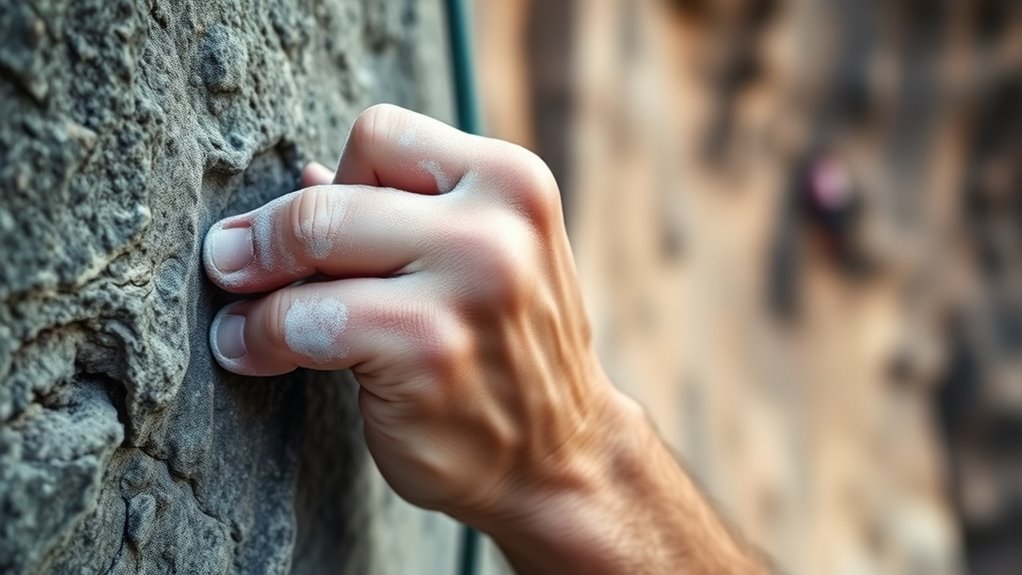
Why does grip strength matter so much in rock climbing? Because your ability to hold onto small or sloping holds directly impacts your climbing performance. Strong grip strength lets you maintain contact longer, boosting endurance and confidence on tough routes.
Research shows climbers have much higher grip strength—around 125.4 lb for men—compared to the average person, proving how essential it is. When you improve grip strength, your fingers and hand strength recover faster on holds, reducing slip risk during tricky moves.
Plus, better grip enhances your upper body stability and control, helping you execute complex techniques safely. Focused training to improve grip strength is key if you want to advance in rock climbing and tackle more technical routes with precision.
Start With Dead Hangs to Build Foundational Grip Strength
Building a solid grip foundation is the next step after understanding its importance in climbing. Dead hangs are perfect for this—they engage your forearm muscles and boost grip strength and endurance.
Here’s how to get started:
- Perform 3 sets of 30-second dead hangs with arms fully extended to increase hold duration.
- Switch grip types—overhand, underhand, pinch—to target different muscles and reduce injury risk.
- Gradually increase hang duration as your grip and endurance improve.
- Add weighted hangs once basic strength is built to maximize grip power.
Dead hangs also decompress your spine and stretch forearm muscles, promoting joint health. By committing to this foundational exercise, you’ll notice better control and stamina during climbing sessions.
Stick with it—you’ll see the difference!
Use Farmers Walks to Strengthen Whole-Body Grip Endurance
Farmers Walks are a simple yet powerful way to boost your grip endurance by carrying heavy weights for 30-60 seconds while keeping your shoulders back and core tight. This technique not only strengthens your hands and forearms but also improves your overall stability and posture.
Adding three sets of Farmers Walks to your routine will help you hold onto tough climbing grips longer. It’s a straightforward exercise that really pays off when you need that extra grip strength. Give it a try and feel the difference!
Benefits of Farmers Walks
Carrying heavy weights in each hand for 30 to 60 seconds can dramatically boost your grip endurance and overall strength. Farmers Walks target your forearm muscles and improve grip control, making them perfect for rock climbers.
Here’s why you should add them to your routine:
- They enhance grip strength, letting you hold on longer to tough climbs.
- They build forearm muscles, increasing your grip endurance during prolonged sessions.
- They improve full-body stability by engaging your core and posture.
- They reduce injury risk by training grip muscles and stabilizers, preventing fatigue-related issues.
Give them a try—you might be surprised how quickly you notice the difference!
Proper Farmers Walk Technique
How should you hold yourself to get the most out of this exercise? During the farmers walk, maintain an upright posture with shoulders back and core engaged to maximize grip endurance.
Your grip technique should focus on a firm hold, preventing weights from swaying or slipping as you walk. Keep a steady pace to maintain control and proper form throughout each set.
Distribute the weight evenly in both hands to avoid uneven strain and promote balanced grip activation. Use heavy dumbbells, plates, or buckets for 30-60 seconds per set, completing three sets in total.
Gradually increase the weight or distance to continuously challenge your grip endurance and strengthen your whole-body grip. This approach guarantees you get the most from your farmers walk.
Incorporate Plate Pinches for Targeted Pinch Grip Improvement
To boost your pinch grip strength, incorporate plate pinches into your training routine. This exercise targets the pinch grip by holding weight plates between your thumb and fingers, which is essential for climbing tough, protruding holds.
Start by holding the plates for 30 seconds on each hand and gradually increase the weight. Doing plate pinches regularly enhances both finger strength and endurance.
Hold plates for 30 seconds each hand, increasing weight to build finger strength and endurance steadily.
Try this 4-step plan to maximize your grip strength gains:
- Use weight plates of varying thickness for diverse pinch challenges.
- Perform plate pinches three times a week for consistent progress.
- Increase the weight as your finger strength improves.
- Focus on maintaining a tight, controlled pinch to simulate climbing demands.
Incorporating plate pinches will make your grip more resilient and ready for advanced climbing moves. Give it a shot and watch your grip get stronger!
Try Towel Pull-Ups to Boost Climbing Grip Strength
Try towel pull-ups by draping towels over a pull-up bar and gripping them tightly as you lift your body. This move targets the forearms and stabilizer muscles, giving you grip strength that mimics real climbing holds.
Start with a few sets of 5-10 reps and increase intensity as your endurance improves. It’s a simple tweak to your routine that can make a big difference for climbing. Give it a shot!
Setup and Technique
When you drape towels over a pull-up bar and grip them tightly, you force your fingers and forearms to work harder than with regular pull-ups. For an effective grip setup and technique, follow these steps:
- Choose sturdy towels that won’t tear under your weight for better hold stability.
- Fold each towel lengthwise to create a thick grip area, boosting forearm strength.
- Grip the towels firmly with your fingers wrapped around, engaging your entire hand.
- Perform 3 sets of 5-10 reps within your training routine to build grip endurance.
This dynamic grip setup challenges muscles differently than static hangs, targeting those critical for climbing. Just focus on controlled movements, and keep your shoulders engaged to avoid injury while maximizing towel pull-ups’ benefits.
Benefits for Climbers
Towel pull-ups offer three key benefits that directly boost your climbing grip strength. They improve finger endurance and hold control by forcing your hands to grip an unstable, slippery surface. This challenges your forearm muscles more than regular pull-ups, enhancing overall climbing performance.
Incorporating towel pull-ups into your training routine thrice weekly helps prevent injuries by strengthening tendons exposed to climbing stress.
| Benefit | Effect on Climbing | Training Impact |
|---|---|---|
| Grip Strength | Better hold control | Enhanced grip stabilizers |
| Finger Endurance | Reduced finger fatigue | Increased climbing stamina |
| Forearm Muscle Power | Stronger pull strength | Improved hold engagement |
| Injury Prevention | Fewer grip-related injuries | Longer training longevity |
| Climbing Performance | Smoother, confident moves | Elevated skill execution |
Give towel pull-ups a try to power up your grip and climb smarter.
Progression and Variations
As you build your grip strength, incorporating variations of pull-ups can challenge your muscles in new ways and accelerate progress. Towel pull-ups increase grip difficulty and simulate real climbing holds, boosting grip endurance effectively.
To optimize your training intensity and exercise progression, try these steps:
- Perform 3 sets of 5-10 reps with towels draped over a pull-up bar.
- Incorporate towel pull-ups 2-3 times weekly to enhance grip endurance steadily.
- Use towels of varying thicknesses or textures to add variety and increase grip difficulty.
- Focus on controlled movements to engage forearm and finger muscles intensely.
This progression and variations approach will simulate climbing stress and prepare your grip for tougher routes. It’ll help you climb stronger and longer.
Add Rice Bucket Training and Antagonist Moves to Prevent Injuries
Although grip strength is essential for rock climbing, neglecting the opposing muscles can lead to imbalances and injuries. Rice bucket training targets small hand and forearm muscles, boosting grip endurance and stability.
Pair it with antagonist exercises like finger extensions and wrist movements to balance muscle development and support injury prevention. Together, these methods reduce tendinitis and pulley injury risks while improving overall forearm strength.
Here’s a quick look at some key exercises:
| Exercise Type | Benefits | Injury Prevention Focus |
|---|---|---|
| Rice Bucket Training | Enhances grip endurance | Supports tendon recovery |
| Finger Extensions | Balances flexor/extensor | Reduces muscle imbalances |
| Wrist Extensions | Strengthens extensors | Prevents overuse injuries |
| Reverse Flys | Improves shoulder health | Supports pulley integrity |
Try to include these exercises 2-3 times a week. It’s a great way to build balanced forearm strength and keep injuries at bay for the long haul.
Progress Gradually and Track Your Grip Strength Gains
When you gradually increase the intensity and duration of your grip exercises, you minimize injury risk while steadily building strength. Progression through incremental adjustments allows your tendons and muscles to adapt safely.
Consistent tracking and measurement ensure you stay on the right path without overtraining. Make assessment a regular part of your training routine.
Follow these steps:
- Increase grip hold times or add weight in small increments.
- Track your grip strength using tools like a dynamometer or record max hang times.
- Perform periodic testing every 4 to 6 weeks to assess progress and adjust training loads.
- Target various grip types (open-hand, crimp, pinch) for balanced development.
This structured approach will help you achieve measurable, lasting grip strength gains.
Frequently Asked Questions
How Does Nutrition Affect Grip Strength Development?
Nutrition directly impacts your grip strength development by fueling muscle growth and repair. You’ll want protein for muscle recovery, healthy fats for joint health, and plenty of hydration to maintain endurance and prevent cramps during training.
Can Grip Strength Training Improve Finger Tendon Health?
Think of your finger tendons as sturdy ropes; grip strength training definitely fortifies them, making them more resilient and less prone to injury. With consistent effort, you’ll build tendon health that supports your climbing grip like steel cables.
What Role Does Mental Focus Play in Grip Endurance?
Mental focus helps you maintain grip endurance by keeping you calm and aware of your hand positioning. When you concentrate, you can better manage fatigue and prevent unnecessary tension, allowing your grip to last longer during climbs.
Are There Specific Supplements for Enhancing Grip Strength?
You can try supplements like creatine, magnesium, and beta-alanine to boost grip strength. They support muscle endurance and recovery, but remember, consistent training and proper nutrition are key. Always check with a professional before starting.
How Do Different Climbing Shoes Impact Grip Effectiveness?
When you lace up tight, aggressive climbing shoes, they cling to tiny edges like a gecko, boosting your grip. Softer shoes mold to holds, offering comfort but less precision. Choose based on your climb’s demands.
Conclusion
Your grip is the anchor that holds you steady on the rock face. By training with dead hangs, farmers walks, and plate pinches, you’re forging a stronger, more reliable hold—like a climber tightening knots in their rope.
Towel pull-ups and rice bucket exercises add layers of resilience, while gradual progress guarantees your grip won’t snap under pressure.
Keep nurturing your strength, and you’ll climb higher, holding onto every challenge with unwavering confidence. Building grip strength is essential for rock climbing success. With consistent training, including these effective exercises, your hands will become more powerful and enduring. This means better control, less fatigue, and the ability to tackle tougher routes. So, stick with it, focus on gradual improvement, and watch your grip strength transform your climbing game.