What Muscles Does Rock Climbing Work?
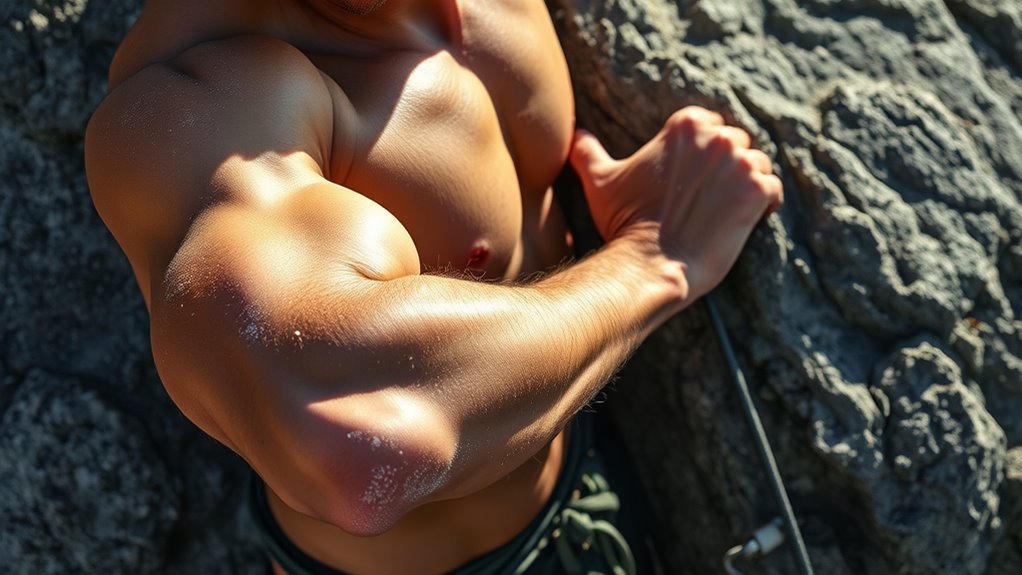
When you rock climb, you work a bunch of muscles all over your body. Your upper body muscles like your lats, biceps, triceps, and shoulders get activated as you pull yourself up and reach for holds. These muscles are key for lifting and moving your body weight.
Your core muscles play a huge role too. They stabilize your body, helping you keep your balance and control while you climb. Without a strong core, it’s tough to stay steady on the wall.
Don’t forget your legs! Your quads and calves push you upward and keep you steady on the holds.
Plus, your fingers are working hard, gripping tightly to secure your position.
All these muscles working together build strength, endurance, and coordination. The more you climb, the more you’ll notice how it shapes your entire body, making you stronger and more agile. Keep at it—you’ll be amazed at what climbing can do for you!
Major Muscle Groups Engaged in Rock Climbing
Although rock climbing demands full-body effort, it primarily works your upper body muscles like the latissimus dorsi, biceps, triceps, deltoids, and trapezius to pull and reach. These muscle groups in your back and shoulder muscles handle most of the muscle engagement during climbs.
Your core muscles, including the rectus abdominis and obliques, act as stabilizer muscles, keeping your body balanced and controlled. Meanwhile, your lower body isn’t idle; your leg muscles—quadriceps, hamstrings, calves, and glutes—push off holds and maintain positioning.
Don’t forget your grip strength, which relies on finger muscles to securely hold onto climbing surfaces. Together, these muscle groups coordinate, making climbing an efficient full-body workout focused on upper body power supported by core stability and lower body strength.
Comprehensive Benefits of Climbing on Strength and Endurance
When you climb regularly, you build strength and endurance across multiple muscle groups at once. The pulling motions boost your upper body’s muscular endurance, especially in your lats, biceps, and finger flexors, enhancing grip strength.
At the same time, your core strength develops as your abs and obliques stabilize your body during complex moves. Your lower body, including glutes and quadriceps, works hard to maintain balance and power.
Over time, climbing promotes hypertrophy, increasing muscle size and resilience. This supports longer climbing sessions with less fatigue.
This dynamic activity improves your functional strength and stamina, enabling you to perform efficiently over extended periods. Overall, climbing offers a extensive workout that elevates both your muscular endurance and full-body strength.
Conclusion
When you climb, you’re not just testing your grip—you’re giving your entire body a workout that hits muscles from your fingers to your core and legs. It’s like killing two birds with one stone: building strength and endurance all at once.
So, next time you hit the wall, remember you’re sculpting more than just your climbing skills—you’re shaping a stronger, fitter you from head to toe. Rock climbing works your forearms, biceps, shoulders, back, and even engages your leg muscles as you push yourself upward.
It’s a full-body exercise that improves muscle tone, balance, and flexibility. Plus, it’s a fun way to challenge yourself physically and mentally. Keep climbing, and you’ll notice your muscles getting stronger and your endurance improving every session!