How to Read a Climbing Carabiner Step by Step
To read a climbing carabiner, start by checking the certification marks like CE or UIAA. These marks guarantee it meets important safety standards, so you know it’s reliable for your climb.
Next, examine the engraved strength ratings. Pay close attention to the major axis and open gate values to make sure they suit the type of climbing you’ll be doing.
Now, identify the shape—D, pear, oval—and understand how it affects performance. Each shape has its own benefits depending on your needs.
Finally, look at the gate type and locking mechanism. These features affect both security and ease of use, which are super important when you’re out there on the rock.
Keep exploring the details to fully grasp how each feature impacts your safety and climbing experience. It’s worth knowing what you’re working with!
Key Takeaways
- Locate and read the certification marks like CE or UIAA to confirm compliance with safety standards. These marks tell you that the carabiner meets important safety criteria.
- Check the engraved strength ratings on the spine for major axis and open gate force capacities. This helps you understand how much weight the carabiner can safely hold.
- Identify the carabiner shape (D, asymmetric D, pear, oval) to understand its intended use and strength benefits. Different shapes serve different purposes, so it’s good to know which one you’re working with.
- Examine the gate type (straight, wire, bent) and locking mechanism (screwgate, auto-lock) for security and usability. This affects how easy it is to open and how secure it will be during use.
- Verify all markings are clear, ensure the locking mechanism functions properly, and inspect for any damage before use. Taking these steps helps keep you safe while climbing.
How to Read Carabiner Certification Marks and Strength Ratings
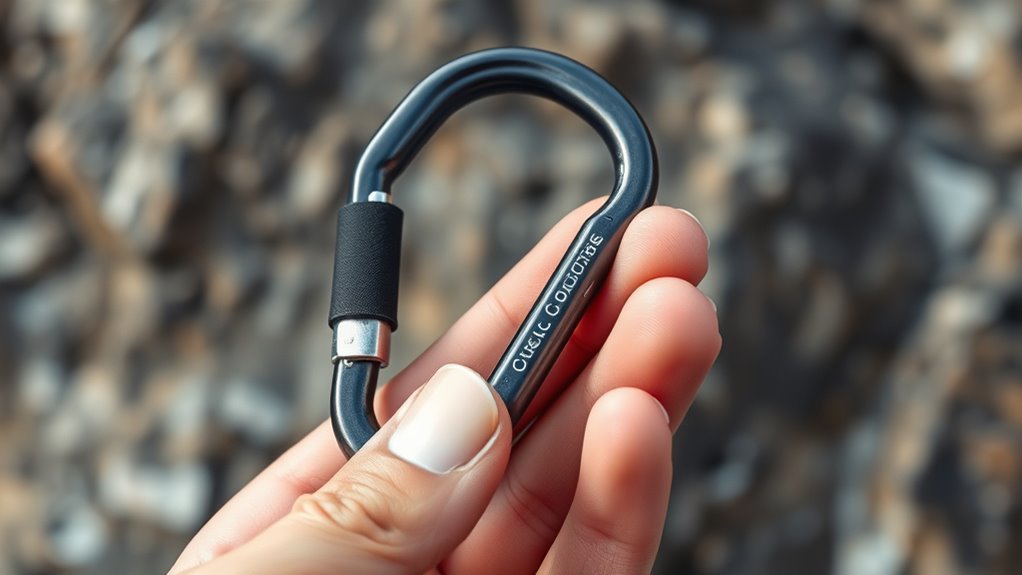
When you pick up a climbing carabiner, you’ll notice certification marks like CE or UIAA stamped on its body—these confirm it meets important safety standards. The CE certification includes a number identifying the lab that tested the carabiner, while UIAA markings show it complies with industry testing protocols.
Alongside these certification marks, you’ll find strength ratings engraved on the spine, such as the carabiner strength for the major axis—often around 20 kN—and the open gate strength, typically lower, near 7 kN. These values indicate the maximum forces the carabiner can handle under different load orientation scenarios.
Before using any carabiner for climbing or safety tasks, always check for clear, legible engraved markings. This way, you can be sure it meets the necessary safety standards and performs reliably under expected loads.
Understanding Carabiner Shapes, Gate Types, and Locking Mechanisms
Although carabiners might look simple, their shapes, gate types, and locking mechanisms play essential roles in how you use them safely and efficiently. Different carabiner shapes like D-shape, asymmetric D, pear, and oval optimize strength, weight, and gear capacity for specific needs.
Gate types vary too: straight-gate models offer durability, while wire gate versions are lighter and resist freezing. Bent-gate carabiners make clipping easier.
Locking mechanisms include screwgate systems that you manually secure and auto-locking twist-locks that lock automatically after opening. Choosing the right combination affects ease of use, security against cross-loading, and suitability for tasks like belaying or gear racking.
Always check strength ratings to guarantee your carabiner matches your climbing demands and keeps you safe.
Frequently Asked Questions
What Do the Numbers on a Climbing Carabiner Mean?
The numbers on a climbing carabiner show its strength ratings in kilonewtons (kN). They tell you how much force the carabiner can handle in different positions, helping you choose the right gear safely.
How to Read Carabiner Code?
You just decode the secret carabiner language—CE and UIAA symbols mean it’s legit, numbers like 20 kN scream strength, and codes reveal model details. Congrats, you’re officially a gear whisperer, not just a climber!
How to Read a Climbing Route Grade System?
You read a climbing route grade by identifying the grading system used, then compare its number or letter to difficulty scales like YDS, French, or UIAA. This helps you gauge the climb’s challenge before starting.
What Is the H Symbol on a Carabiner?
Think of the “H” on a carabiner as a lighthouse—it signals that you’re holding an HMS type, perfect for belaying and rappelling. Don’t just trust the symbol; always check its shape and specs before you clip in.
Conclusion
Now that you know how to read your climbing carabiner’s certifications, shapes, and locking types, you’re better equipped to choose the right gear for your climb. Remember, “measure twice, cut once” applies here—double-check those ratings and mechanisms before trusting your life to them.
Taking these extra seconds guarantees your safety on the wall and lets you climb with confidence every time. Staying sharp with your gear knowledge is just as important as physical strength when it comes to climbing. So, always pay close attention to your carabiner’s details before every climb.
By understanding how to read a climbing carabiner, you ensure that you pick the best equipment for your needs, keeping safety front and center. This careful approach helps you avoid accidents and enjoy your climbing adventures with peace of mind. Stay sharp, and climb smart!