Top 10 Skyscrapers Alex Honnold Has Climbed
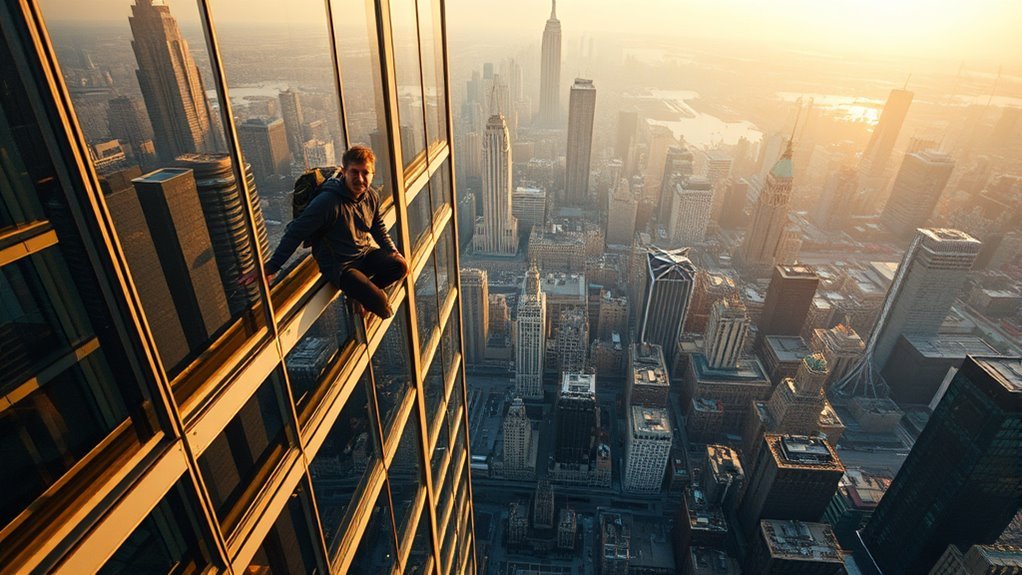
You’ve witnessed Alex Honnold tackle some of the tallest urban giants, like his groundbreaking free solo of Taipei 101—a 1,667-ft climb streamed live to millions. Urban free soloing is no joke, and Honnold’s climbs push both physical and mental limits.
He’s challenged architectural marvels that have tested climbers for years. In fact, he even surpassed iconic feats like Alain Robert’s Petronas Towers ascent. Pretty impressive, right?
While the Burj Khalifa remains unclimbed without protection, Honnold’s efforts continue redefining what’s possible in skyscraper climbing.
Keep exploring to uncover the full story behind these daring skyscraper climbs. You won’t want to miss how these urban adventures unfolded!
Key Takeaways
- Alex Honnold’s notable skyscraper climb includes Taipei 101 (1,667 ft), completed free solo in 1 hour 31 minutes in 2023.
- The Taipei 101 climb was livestreamed globally, showcasing Honnold’s advanced techniques on overhangs and observation decks.
- Honnold’s Taipei 101 ascent surpasses Alain Robert’s Petronas Towers (1,483 ft) climb in continuous free solo height.
- He has not publicly free soloed Burj Khalifa (2,716 ft), the tallest skyscraper yet unclimbed without protection.
- Honnold’s skyscraper climbs emphasize technical difficulty (~5.11 rating) and push urban free solo limits worldwide.
Urban Free Soloing Explained: What Makes It Unique
Although it may seem reckless, urban free soloing challenges you to climb towering buildings without any safety gear, relying entirely on your skill and focus. Unlike traditional climbing, urban free soloing demands you navigate complex architectural features like overhangs, spires, and observation decks.
These elements create unique technical challenges that test your precision and mental toughness. You often tackle these ascents alone, making every move unpredictable and risky.
The scale is impressive too, with some climbs soaring beyond 1,600 feet, pushing your limits against gravity and height. However, urban free soloing isn’t just about personal achievement—it raises serious safety and ethical questions.
That’s because of the dangers involved and the crowded city environments where these daring climbs take place. It’s definitely not for the faint of heart!
Alex Honnold’s Historic Taipei 101 Free Solo Climb
How did Alex Honnold manage to free solo Taipei 101, one of the tallest skyscrapers in the world? On January 24, Honnold completed a historic climb up the 1,667-foot landmark in just over 1 hour and 31 minutes.
During the “Skyscraper Live” event, thousands watched him livestream the ascent with a 10-second delay on Netflix. You’d face tough overhangs, windy conditions, and fatigue, just like Honnold did, relying on heel hooks and pinches to navigate the building’s distinctive “ruyis.”
The climb sparked debate over whether it’s the biggest urban free solo compared to others. But Honnold described the experience as “infinite,” saying he felt more at ease atop Taipei 101 than on its side.
Alain Robert’s Urban Free Solo on the Petronas Towers
One of the most daring urban free solo climbs in history happened in 1997 when Alain Robert, known as “Spiderman,” scaled the Petronas Twin Towers in Kuala Lumpur without any safety gear. You can hardly imagine the courage it took to climb these 1,483-foot twin towers before their official completion.
Alain Robert’s ascent was continuous and completely unprotected, making it one of the tallest urban free solo climbs ever. This feat not only grabbed global headlines but also cemented Alain Robert’s status as a pioneer in urban climbing.
| Aspect | Detail | Significance |
|---|---|---|
| Climber | Alain Robert | Renowned urban free soloist |
| Location | Petronas Twin Towers | World’s tallest twin buildings |
| Height | 1,483 feet (452 meters) | Iconic daring achievement |
Dan Goodwin’s CN Tower Climb: A Non-Traditional Free Solo
When Dan Goodwin tackled Toronto’s CN Tower in 1986, he didn’t just climb—it was a carefully staged effort involving multiple attempts rather than a continuous free solo ascent. You’ll notice his climb doesn’t fit the traditional free solo mold because it wasn’t one seamless push.
Instead, Goodwin’s approach was non-continuous, making it distinct from pure free solo records. Still, his feat remains iconic in urban climbing, proving the challenge of scaling skyscrapers without safety gear.
Remarkably, Goodwin himself has argued that reaching observation decks shouldn’t be counted as urban free soloing. Despite this, his CN Tower climb inspired many and stands as one of the earliest examples of free soloing a major skyscraper.
It paved the way for future urban climbers who pursue more uninterrupted ascents. Pretty impressive, right?
Burj Khalifa Attempts and Their Role in Free Solo History
Although Alex Honnold hasn’t attempted to free solo the Burj Khalifa, this towering 2,716-foot skyscraper remains a powerful symbol in the world of urban climbing. While it’s the tallest building globally, its sheer height and required safety ropes make true free soloing impossible.
You’ll often hear the Burj Khalifa mentioned in debates about the limits of urban free soloing.
Imagine climbing the Burj Khalifa with its gleaming glass facade reflecting the desert sun and winds whipping around its spire. The dizzying height surpasses Taipei 101 by over 1,000 feet.
Of course, safety ropes and complex rigging are essential for any ascent.
The Burj Khalifa challenges climbers’ imaginations and marks an aspirational peak in free solo history. Even though it hasn’t been conquered without protection, it still holds a special place in the climbing world.
Comparing the Height and Difficulty of Iconic Urban Free Solos
Comparing the height and difficulty of iconic urban free solos reveals how climbers like Alex Honnold and Alain Robert push the limits of what’s possible on towering structures. You’ll notice Honnold’s Taipei 101 climb at 1,667 feet surpasses Alain Robert’s Petronas Twin Towers ascent of 1,483 feet, making it one of the highest continuous free solos to the top of the building.
While Robert’s Burj Khalifa climb reaches 2,716 feet, he used ropes, so it’s not a pure free solo. Difficulty ratings also vary: Honnold’s Taipei 101 is around 5.11, comparable to Robert’s 5.5–6, both extremely challenging.
Debates about whether spires and observation decks count toward height complicate comparisons, but the risk and skill required remain undeniable. It’s clear these climbers are redefining what’s possible in urban climbing.
Physical and Weather Challenges in Free Solo Skyscraper Climbs
Beyond height and technical difficulty, free solo climbs on skyscrapers like Taipei 101 test a climber’s physical endurance and ability to handle unpredictable weather. When you attempt such a climb, you face unique challenges that push your limits.
Free solo skyscraper climbs push climbers’ endurance and weather resilience to their absolute limits.
For example, you’re battling gusty winds and sudden rain that make holds slippery and increase risk. Plus, you have to navigate overhanging bamboo box-like structures that demand advanced techniques like heel hooks and pinches.
On top of that, managing muscle fatigue in your arms and legs from continuous strain without rest is a huge deal. And timing your climb carefully to avoid weather delays that could prove dangerous is super important.
These weather and physical challenges make each free solo skyscraper climb an intense test of skill and resilience. Despite all that, climbers like Honnold find a strange comfort atop, feeling almost infinite after conquering the ordeal.
Live Broadcasts and Public Reactions to Honnold’s Taipei 101 Climb
When Alex Honnold began his free solo ascent of Taipei 101, thousands of viewers tuned in to a Netflix livestream with only a 10-second delay. This turned the climb into a worldwide event.
You’d see fans and media gathering, capturing selfies and cheering from the building’s windows as the live broadcast unfolded. Honnold waved to the cameras and celebrated atop the skyscraper, creating a genuine connection with the online audience.
The live broadcast sparked lively debates about the ethics and safety of airing such dangerous climbs in real time. While many admired Honnold’s skill and bravery, others worried about the risks of urban free soloing being showcased live to millions.
You couldn’t help but feel both exhilaration and concern witnessing the climb as it happened.
Key Partners and Commentators Supporting Honnold’s Urban Climbs
You’ll notice that expert commentators like Emily Harrington bring valuable climbing insights during Honnold’s ascents, enhancing your understanding of the challenges he faces.
His climbs also rely heavily on support from trusted partners and local authorities who provide necessary permissions and safety oversight. This network of collaborators plays a vital role in making his urban climbs possible and credible.
Expert Commentary Roles
Although Alex Honnold’s solo climbs capture most of the spotlight, expert commentators like Emily Harrington play an essential role in breaking down the technical challenges behind his urban ascents.
Their expert commentary helps you grasp the complexity and risks involved in free soloing skyscrapers. Unlike uninformed remarks from non-climbers, Harrington’s insights highlight key details, such as:
- The difficulty of using “ruyis” as handholds
- The strategic application of heel hooks
- The intensity of the top crux section
- The physical and mental demands of urban free soloing
Climbing Partners Involvement
Expert commentary not only sheds light on the technical demands of Honnold’s climbs but also highlights the teamwork behind the scenes. Climbing partners play an essential role in supporting his urban ascents, often providing real-time insights and safety logistics.
For instance, during the Taipei 101 climb, a crew suspended from fixed ropes ensured the live broadcast ran smoothly, balancing safety with complexity. Friends, family, and climbing partners stood by in Taiwan, offering moral support and firsthand witness to the feat.
Experts like Emily Harrington, a seasoned climber, delivered precise commentary that enriched viewers’ understanding of the technical challenges. These climbing partners and knowledgeable commentators form the backbone of Honnold’s urban climbs, blending expertise and encouragement without overshadowing his solo efforts.
Local Authority Support
Several local authorities played an essential role in supporting Alex Honnold’s climb of Taipei 101, providing official authorization and logistical coordination. Their local authority support guaranteed the climb was safe, legal, and celebrated rather than risky or unauthorized.
You’d see how officials praised the event for showcasing Taiwan’s innovation and modernity, emphasizing the building’s cultural significance. The Taipei City Government and building management worked closely with Honnold to coordinate safety measures and smooth execution.
Key highlights of local authority support include:
- Official authorization from Taipei’s municipal government
- Collaboration on safety protocols with building management
- Public praise from local commentators and officials
- Framing the climb as a proud moment for Taiwan’s global image
This support was essential in making the climb a landmark event.
Future Prospects for Alex Honnold and Urban Free Soloing
As Alex Honnold continues to push the limits of urban free soloing, you can expect him to target more skyscrapers in the future. He’s driven by the thrill and challenge they offer.
His Taipei 101 ascent has not only elevated his profile but also sparked debates about the safety, legality, and ethics of urban free soloing. These discussions will shape the kinds of climbs he pursues next.
Especially since the definition of a legitimate urban free solo—whether involving spires, observation decks, or entire buildings—is still unsettled. While Honnold’s daring feats inspire a new generation of urban climbers, they also highlight the risks and controversies tied to high-profile solo ascents.
Still, his willingness to embrace these challenges suggests urban free soloing will evolve as a bold, if contentious, niche in climbing. It’s definitely an exciting space to watch.
Frequently Asked Questions
What Skyscraper Has Alex Honnold Climbed?
You’d be amazed to know Alex Honnold has climbed Taipei 101 without ropes, tackling its 1,667 feet height. You can imagine the skill it takes to free solo such a massive skyscraper safely and quickly.
What Did Alex Honnold Climb to the Highest Building in the World?
You climbed Taipei 101 to reach the highest building, conquering 1,667 feet like scaling a mountain in the sky. You did it free solo, without ropes, proving fearless determination beats any ladder or elevator.
How Fast Did Alex Honnold Climb the Skyscraper?
Alex Honnold climbed the skyscraper in about 1 hour, 31 minutes, and 34 seconds. You’d see him maintain a steady pace, tackling overhangs nonstop, all without safety gear, showing incredible focus and endurance throughout.
How Much Did Alex Honnold Get Paid to Climb a Skyscraper?
You probably won’t find any record of Alex Honnold getting paid directly to climb skyscrapers. He usually does it for personal challenge, environmental causes, or media projects, not for specific payment per climb.
Conclusion
You’ve witnessed Alex Honnold dance with giants, scaling steel and glass like a shadow weaving through city lights. Each skyscraper he conquers isn’t just a climb—it’s a heartbeat of urban adventure echoing against the sky.
As you imagine his next daring ascent, remember: free soloing these towering titans is more than a feat; it’s a symphony of courage and grace. It dares you to dream bigger and reach higher.
Climbing these iconic skyscrapers showcases not only Alex Honnold’s incredible skill but also the spirit of adventure and determination. His climbs inspire us to push boundaries and embrace the thrill of urban exploration. So when you think about the top skyscrapers Alex Honnold has climbed, know that each climb is a testament to human courage, precision, and the endless pursuit of breathtaking challenges.